

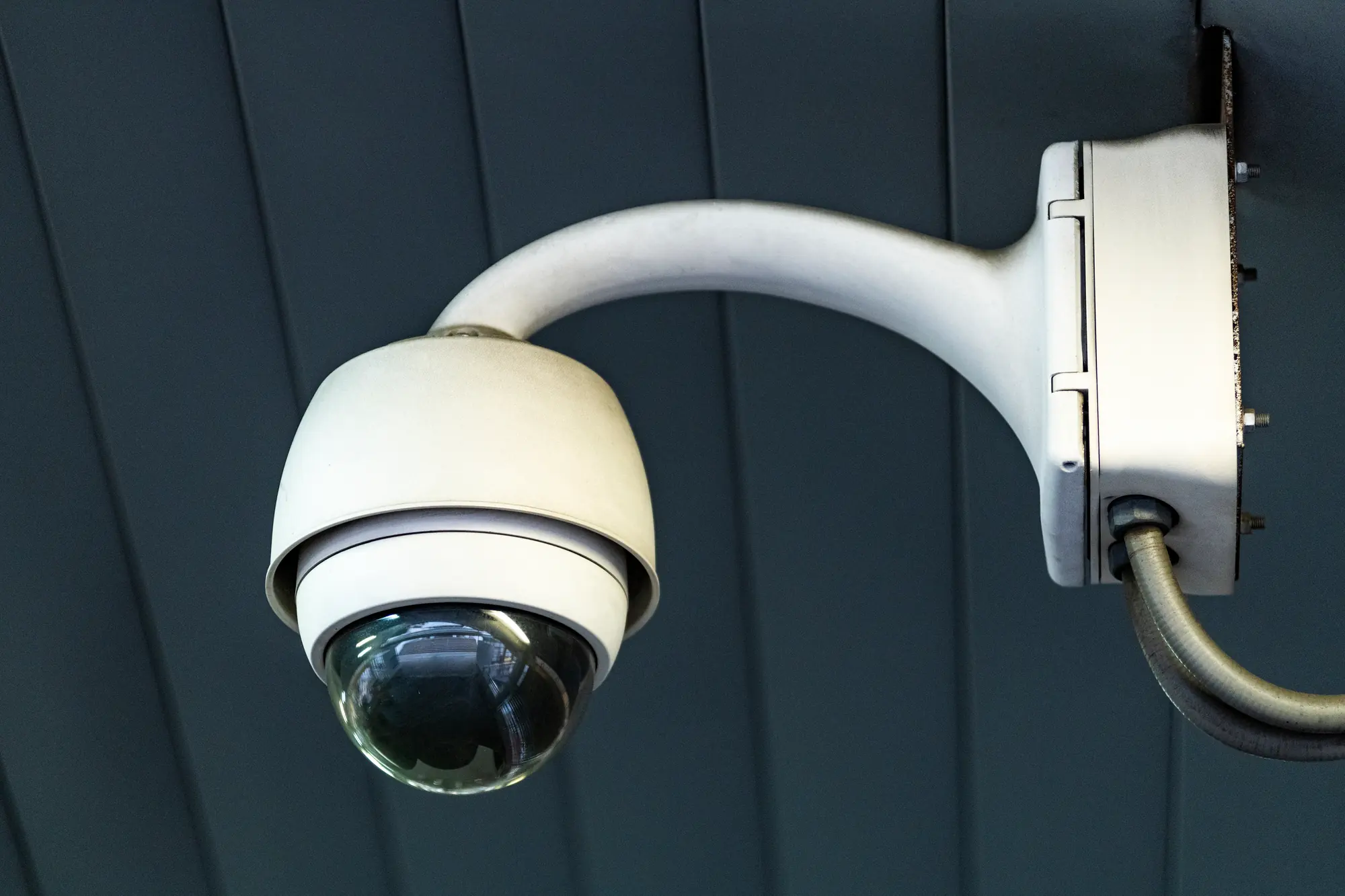
An installed CCTV system in Mumbai and Thane costs indicatively ₹10,000 to ₹14,000 for two HD cameras, ₹18,000 to ₹28,000 for four, ₹35,000 to ₹55,000 for eight, and ₹65,000 to ₹1,10,000 for sixteen, including the recorder, a hard disk, cabling and labour. Switching from HD analogue to IP cameras adds roughly 30 to 50 percent, and buys you sharper footage, smarter analytics and easier expansion. Storage for 30 days of continuous recording on a 4 camera system needs a 2 TB disk; on sixteen cameras you are into 8 to 12 TB.
Those are the headline numbers. The rest of this guide explains what sits inside each package, how to choose between HD and IP, how many days of footage you really need, and what housing societies in Thane and Mumbai should think about before the AGM votes on it. For an installation quote, our CCTV installation team surveys the site first, free of charge within Thane, Mumbai and Navi Mumbai.
Indicative CCTV package prices (2026)
Prices below assume 2 MP cameras for HD and 4 MP for IP, a branded recorder (CP Plus, Hikvision, Dahua or Uniview), a surveillance-grade hard disk, copper or Cat6 cabling up to typical runs, a small power supply or PoE switch, mounting and configuration with mobile viewing.
| Package | HD (analogue over coax) | IP (PoE network cameras) | Typical use |
|---|---|---|---|
| 2 cameras | ₹10,000 to ₹14,000 | ₹16,000 to ₹22,000 | Flat entrance, small shop counter |
| 4 cameras | ₹18,000 to ₹28,000 | ₹28,000 to ₹42,000 | Clinic, coaching class, bungalow, small office |
| 8 cameras | ₹35,000 to ₹55,000 | ₹55,000 to ₹90,000 | Restaurant, warehouse, mid-size office, small society |
| 16 cameras | ₹65,000 to ₹1,10,000 | ₹1,10,000 to ₹1,80,000 | Housing society, school, factory floor |
Add-ons that move the price:
- Higher resolution (5 MP or 8 MP/4K): ₹1,500 to ₹5,000 more per camera.
- Colour night vision or active deterrence (white light, siren): ₹1,500 to ₹3,500 per camera.
- Long cable runs past 60 to 80 metres, conduit work on external walls, or trenching for compound gates: quoted per metre.
- Larger hard disks: a 4 TB surveillance disk is roughly ₹9,000 to ₹11,000, 8 TB about ₹18,000 to ₹22,000.
- Monitor at the security cabin: ₹7,000 to ₹12,000 for a 22 to 24 inch display.
- UPS so cameras ride out power cuts: ₹4,000 to ₹15,000 depending on runtime; see our UPS sizing calculator.
Browse current CCTV cameras and recorders to see what is in stock.
HD analogue vs IP cameras: which should you choose?
| HD analogue (HD-TVI/CVI/AHD) | IP (network, PoE) | |
|---|---|---|
| Image quality | 2 MP to 5 MP, good in daylight | 4 MP to 8 MP, better detail and low light |
| Cabling | Coax plus separate power, or 3+1 cable | One Cat6 cable carries video and power (PoE) |
| Expansion | Limited by DVR channel count | Add cameras to any switch port |
| Analytics | Basic motion | Line crossing, intrusion zones, people and vehicle detection, face capture on higher models |
| Remote viewing | Yes, via DVR app | Yes, usually smoother and per-camera |
| Cost | Lower | 30 to 50 percent higher |
| Best for | Budget upgrades of existing coax installs, small shops | New installs, societies, offices, anywhere you may expand |
Our rule of thumb: if you are pulling new cable, pull Cat6 and go IP. The cable is the expensive part to redo later, and IP cameras can be re-used on a future recorder. If you already have coax in the walls and a working DVR, HD cameras are a sensible, cheap refresh.
How many days of recording do you need?
Most homes and shops want 15 to 30 days. Housing societies often settle on 30 days because incidents are reported late, and some insurers and police requests want footage from two to four weeks back. Storage depends on resolution, frame rate, compression (H.265 roughly halves H.264) and whether you record continuously or on motion.
Indicative continuous recording at 15 fps with H.265:
| Cameras | 2 MP for 30 days | 4 MP for 30 days | 4 MP for 60 days |
|---|---|---|---|
| 4 | 2 TB | 4 TB | 8 TB |
| 8 | 4 TB | 8 TB | 16 TB |
| 16 | 8 TB | 16 TB | 32 TB (two disks or NAS) |
Motion-based recording can cut these by half or more in quiet areas but not at a busy gate. Run your own numbers in the CCTV storage calculator. For societies that want 90 days or want footage kept off-site, pairing the NVR with a NAS is cleaner than stacking disks in the recorder.
Where cameras should go
A good survey beats a longer camera list. The usual coverage plan:
- Entry and exit points at head height for faces, with a second wide camera for context.
- Cash counter or reception, angled to see hands and the screen edge, never the keypad of a card machine.
- Parking and compound, with cameras covering vehicle approach and number plates near the gate; a dedicated 4 MP or higher camera at 10 to 15 fps works far better than hoping a wide-angle dome will read plates.
- Lifts and lobbies in societies, which also deters vandalism and settles "who left the wet umbrella" arguments.
- Staircases and terrace doors, often forgotten and often the route for break-ins.
- Server or store rooms in offices.
Avoid pointing cameras into neighbours' windows or private flats. In societies, common areas only.
Mumbai and Thane specifics: monsoon, heat, power
- Weatherproofing. Outdoor cameras must be IP66 or IP67, and the junction boxes matter as much as the camera. Water in a connector is the most common monsoon fault we see.
- Heat. Recorders in a sealed cupboard above a shop shutter cook in May. Give the DVR/NVR ventilation and keep the hard disk under 50 degrees for a longer life.
- Power cuts. A small UPS on the recorder and PoE switch keeps recording through the typical 20 to 90 minute outage. Cameras on the same UPS are a bonus.
- Lightning and surges. Surge protection on long outdoor cable runs is cheap insurance for compound and gate cameras.
- Rats and pigeons. Run cables in conduit and seal duct openings. Yes, really.
Housing society CCTV: norms and process
Thane and Mumbai societies commonly go through the following:
- Pass a resolution at the general body meeting approving the system, the budget, the camera locations and the retention period. Minute it.
- Common areas only. Gates, lobbies, lifts, parking, terrace access and the compound. No cameras facing into flats or windows.
- Display notices at entrances stating that CCTV is in operation.
- Access control. Decide who can view live and recorded footage, usually the secretary, chairman and security agency, with a simple log of footage requests. Residents asking for footage should go through the committee.
- Retention. 30 days is the common default. Set the recorder to overwrite automatically.
- Maintenance. A CCTV AMC with quarterly cleaning, a health check of every camera and a disk health report avoids finding out a camera died three months ago on the day you need it.
Many societies combine CCTV with a video door phone or boom-barrier access, and some pair it with biometric attendance for housekeeping staff.
Questions to ask before you sign
- Which brand and exact model of camera and recorder? Avoid unbranded "2 MP night vision" boxes.
- Is the hard disk a surveillance-grade drive (WD Purple, Seagate SkyHawk)?
- What cable and connectors? Pure copper Cat6 or RG59 with proper compression fittings, not CCA.
- Is mobile viewing set up with strong passwords and the default password changed?
- What is the warranty on cameras (typically two years), recorder and disk, and what does labour cost after it?
- Do you provide a camera layout drawing and a configuration backup?
FAQ
How much does a 4 camera CCTV installation cost in Mumbai?
Indicatively, a 4 camera 2 MP HD CCTV system installed in Mumbai or Thane costs ₹18,000 to ₹28,000, including a 4 channel DVR, a 1 or 2 TB surveillance disk, cabling, mounting and mobile viewing setup. A 4 camera IP system with 4 MP PoE cameras and an NVR costs about ₹28,000 to ₹42,000.
How much does CCTV for a housing society cost?
A 16 camera IP system for a small to mid-size society in Thane or Mumbai is indicatively ₹1,10,000 to ₹1,80,000 installed, covering gates, lobbies, lifts, parking and terrace doors with 30 days of storage. Larger societies with 32 or more cameras, a security cabin monitor and a UPS commonly budget ₹2,50,000 to ₹4,50,000.
How many days of CCTV footage should I keep?
Most homes and shops keep 15 to 30 days; housing societies and offices usually keep 30 days because incidents are often reported late. A 4 camera 2 MP system needs about 2 TB for 30 days of continuous H.265 recording, and 8 cameras at 4 MP need about 8 TB. Motion-only recording can halve this.
Need a hand?
We survey the site, mark camera positions on a plan, and quote a fixed installed price for Thane, Mumbai and Navi Mumbai. Contact Onus Solutions or call +91 99679 77861.